

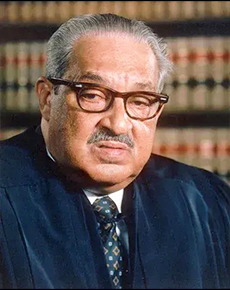
Thurgood Marshall was a lawyer and a judge who strove to protect the rights of all citizens. He was the first African American Justice of the Supreme Court. He was born on June 2, 190,8 in Baltimore, Maryland. In high school, he was introduced to the United States Constitution as part of a punishment for a school prank. Marshall liked the document and took special interest in Article III and the Bill of Rights. Article III establishes the judicial branch of government and the Bill of Rights lists the rights that all American citizens are supposed to enjoy. Marshall was aware of the racial injustices in America and knew that the courts might be the best means for changing them. While working with Charles Hamilton Houston at the NAACP Legal Defense and Education Fund, Marshall realized that the holding in Plessy v. Ferguson (1896) was inherently flawed since “separate” could never be “equal.” Together with Houston, Marshall participated in many civil rights cases and took over the NAACP Legal Defense and Education Fund when Houston returned to private practice. He won several cases that established precedents for chipping away at Jim Crow laws in higher education and went on to argue the case of Brown v. Board of Education (1954) in front of the Supreme Court. He won that case, having the Supreme Court declare that segregated public schools were unconstitutional. He went on to argue many more civil rights cases. In 1967, President Lyndon Johnson appointed him to the United States Supreme Court, where he served until his retirement in 1991. Thurgood Marshall died in 1993, leaving behind a legacy that earned him the nickname, “Mr. Civil Rights.”
